Stem Cells Treat Metatchromatic Leukodystrophy


Metachromatic  leukodystrophy is a genetic brain disease.  The exciting thing in the report below is that just using GMO stem cells (viral carrier for the corrected gene) to correct the bone marrow DNA was enough to arrest the disease, at least as far as was reported--the treatment is too new to report long term results.
The (potentially) cured patients would be GMO people, but be all the healthier for that.

Science DOI: 10.1126/science.1233158
  • RESEARCH ARTICLE

Lentiviral Hematopoietic Stem Cell Gene Therapy Benefits Metachromatic Leukodystrophy

  1. Luigi Naldini1,4,§
+Author Affiliations
  1. 1San Raffaele Telethon Institute for Gene Therapy (TIGET), San Raffaele Scientific Institute, 20132 Milan, Italy.
  2. 2TIGET Pediatric Clinical Research Unit, Division of Regenerative Medicine, Stem Cells and Gene Therapy, San Raffaele Scientific Institute, 20132 Milan, Italy.
  3. 3Pediatric Immunohematology and Bone Marrow Transplant Unit, San Raffaele Scientific Institute, 20132 Milan, Italy.
  4. 4Vita-Salute San Raffaele University, 20132 Milan, Italy.
  5. 5Neurology Unit, Department of Neurology, San Raffaele Scientific Institute, 20132 Milan, Italy.
  6. 6Neuroradiology Unit, Head and Neck Department, San Raffaele Scientific Institute, 20132 Milan, Italy.
  7. 7Department of Experimental Medicine and Biochemical Sciences, University of Perugia, 06122 Perugia, Italy.
  8. 8MolMed S.p.A., 20132 Milan, Italy.
  9. 9Distributed Computing Group, Center for Advanced Studies, Research and Development in Sardinia (CRS4), 09010 Pula, Italy.
  10. 10Pediatric Hematology Oncology Division, Rafic Hariri University Hospital, Beirut, Lebanon.
  11. 11Department of Pediatrics, University of Nebraska Medical Center, Omaha, NE 68198, USA.
  12. 12Molecular and Cellular Technologies, GlaxoSmithKline, Stevenage 5G1 2NY, UK.
  13. 13Pediatric Blood and Marrow Transplantation Program, University Medical Center 3584 CX Utrecht, Netherlands.
  14. 14Department of Translational Oncology, National Center for Tumor Diseases and German Cancer Research Center, 69120 Heidelberg, Germany.
  15. 15Hematology and Bone Marrow Transplant Unit, San Raffaele Scientific Institute, 20132 Milan, Italy.
  16. 16Center for Translational Genomics and BioInformatics, San Raffaele Scientific Institute, 20132 Milan, Italy.
  17. 17Regenerative Medicine Discovery Performance Unit, GlaxoSmithKline Research and Development, King of Prussia, PA 19406, USA.
  18. 18Bone Marrow Transplant Unit, MBBM Foundation, Pediatric Department, Milano-Bicocca University at San Gerardo Hospital, 20052 Monza, Italy.
  19. 19University of Rome Tor Vergata, 00133 Rome, Italy.
  1. §To whom correspondence should be addressed. E-mail: biffi.alessandra@hsr.it (A.B.); naldini.luigi@hsr.it (L.N.)
  1. * These authors contributed equally to this work.
Metachromatic leukodystrophy (MLD) is an inherited lysosomal storage disease caused by arylsulfatase A (ARSA) deficiency. Patients with MLD exhibit progressive motor and cognitive impairment and die within few years of symptom onset. We used a lentiviral vector to transfer a functional ARSA gene into hematopoietic stem cells (HSCs) from three presymptomatic patients who showed genetic, biochemical, and neurophysiological evidence of late infantile MLD. After reinfusion of the gene-corrected HSCs, the patients showed extensive and stable ARSA gene replacement, which led to high enzyme expression throughout hematopoietic lineages and in cerebrospinal fluid. Analyses of vector integrations revealed no evidence of aberrant clonal behavior. Notably, the disease did not manifest or progress in the three patients 7 to 21 months beyond the predicted age of symptom onset. These findings indicate that extensive genetic engineering of human hematopoiesis can be achieved with lentiviral vectors and that this approach may offer therapeutic benefit for MLD patients.

How the media can lie about neuroscience statistics in the news

"H1N1 Vaccine Associated With Small but Significant Risk of Guillain-Barre Syndrome" screams the headline of a neuroscience news site.

Well, okay at first glance.  After all, it is a fact that one can get GBS after immunization. But what are the ACTUAL ODDS? What are the actual numbers, based on a recently published (in JAMA) study done in Quebec?

The population of Quebec: 7825803 (about 8 million), in 2009 (see here). Those vaccinated for the H1N1 strain of inflenza in Quebec in 2009, during or the study time interval: about 4400000 (4.4 million).

There were 83 cases confirmed of Guillain-Barre syndrome around then, of which 25 were from individuals dosed with the H1N1 vacccine within 8 weeks of disease onset. So, we have 25 cases out of 4.4 million and (83 - 25), or 58 cases out of ( 7825803 - 4400000 ) = 3825803.

Relative risk calculation: ( 25 / 4400000 ) / ( 58 / 3825803 ) = 0.375.

So, the statistics indicate that the vaccine was associated with a DECREASED risk of Guillain-Barre compared to not getting the vaccine. 

In fact, those who got H1N1 got Guillain-Barre during the period just after immunization had 2.6 times LESSER risk of getting Guillain-Barre versus someone who did not get the vaccine in that same period.

This is not first class evidence, of course: the population was not randomized.  Furthermore, if we include the 17 cases of GBS in those who were immunized prior to the 8 week interval, who were therefore counted in the 58 cases felt to be unrelated to immunization, we get a more even distribution, befitting the altered time intervals: 42 immunized cases and 41 non-immunized cases. The resulting trend is still biased by 11% toward immunization protecting against GBS even then: relative risk ( 42 / 4400000 ) / (41 / 3825803 ) = 0.89.

Thus, looking at the numbers, we can see how the headline given in the news can show how badly the media can be biased against belief in the safety of immunizations today. It is concerns about safety, promoted by media scare stories, that may drive resistance to immunization in some Americans.

-----------------------------

ABSTRACT

AUTHORS: Philippe De Wals, PhD; Geneviève Deceuninck, MD; Eveline Toth, MSc; Nicole Boulianne, MSc; Denis Brunet, MD; Renée-Myriam Boucher, MD; Monique Landry, MD; Gaston De Serres, PhD

TITLE: Risk of Guillain-Barré Syndrome Following H1N1 Influenza Vaccination in Quebec.

Context  In fall 2009 in Quebec, Canada, an immunization campaign was launched against the 2009 influenza A(H1N1) pandemic strain, mostly using an AS03 adjuvant vaccine. By the end of the year, 57% of the 7.8 million residents had been vaccinated.
Objective  To assess the risk of Guillain-Barré syndrome (GBS) following pandemic influenza vaccine administration.

Design  Population-based cohort study with follow-up over the 6-month period October 2009 through March 2010. The investigation was ordered by the chief medical officer of health in accordance with the Quebec Public Health Act.

Setting  All acute care hospitals and neurology clinics in Quebec.

Population  Suspected and confirmed GBS cases reported by physicians, mostly neurologists, during active surveillance or identified in the provincial hospital summary discharge database. Medical records were reviewed and cases classified according to Brighton Collaboration definitions (categorized as level 1, 2, or 3, corresponding to criteria of decreasing certainty in diagnosis). Immunization status was verified and denominators were estimated from the provincial immunization registry (4.4 million vaccinated) and census data (total target population aged ≥6 months, 7.8 million), with a total of 3 623 046 person-years of observation.

Main Outcome Measures  Relative and attributable risks were calculated using a Poisson model and the self-controlled case-series method.

Results  Over a 6-month period, 83 confirmed GBS cases were identified, including 71 Brighton level 1 through 3 cases. Twenty-five confirmed cases had been vaccinated against 2009 influenza A(H1N1) 8 or fewer weeks before disease onset, with most (19/25) vaccinated 4 or fewer weeks before onset. In the Poisson model, the age- and sex-adjusted relative risk was 1.80 (95% CI, 1.12-2.87) for all confirmed cases during the 8-week postvaccination period and was 2.75 (95% CI, 1.63-4.62) during the 4-week postvaccination period. Using the self-controlled case-series method, relative risk estimates during the 4-week postvaccination period were 3.02 (95% CI, 1.64-5.56) for all confirmed cases (n = 42) and 2.33 (95% CI, 1.19-4.57) for Brighton level 1 through 3 cases (n = 36). The number of GBS cases attributable to vaccination was approximately 2 per 1 million doses. There was no indication of an excess risk in persons younger than 50 years.
Conclusions  In Quebec, the 2009 influenza A(H1N1) vaccine was associated with a small but significant risk of GBS. It is likely that the benefits of immunization outweigh the risks.

JAMA. 2012;308(2):175-181. doi:10.1001/jama.2012.7342.


Natural Kinds, Complexity, and the Particular: Part 2 (regarding causality, natural laws, and unversals)

In Part 1, we saw that DeLanda's universals were based on probability manifolds which shape the tendencies of complex systems by causing a tendency for them to take on particular states.  Thus, emergent properties of complex systems are a consequence of the mathematical properties described by fields including chaos theory and dynamics, and the emergence of these properties are described by the nature of the universals that mathematically describe the shape, statistically, of that system's points of stability.

Is description causation?  No, but what if the description fits a rule of how something behaves? Is that rule a cause? Are natural laws descriptive or causal, or both?  Hard to say.  We will assume they are causative in some sense in what follows.

Examples can be offered in physics, biology, and behavior. In physics, we can consider the orbital of an electron, say that of a ground state (point of stability) electron as part of the typical hydrogen atom (a proton-electron pairing). The orbital of the electron is described by a probability manifold, with higher probabilities that the electron will be located in any given time interval in the space near but not immediately adjacent to the proton nucleus of the atom:


The parameters (natural laws and their consequences, if you like) governing the orbital's probability space are a kind of abstract universal, which interacts with a physical object (the hydrogen atom) to cause an emergent phenomenon (the hydrogen atoms's physical and chemical properties).  This is causal interaction (formal causation) by the probability manifold on the physical object (the electron).

In biology, we can consider the computer model of the Mycoplasma cell constructed by Karr et al and published in 2012 in the journal Cell. In that model, protein, RNA, and DNA replication could be predicted and analyzed as an emergent phenomenon given the cell's genome.  The parameters and causal direction given to the simulation are analagous to the ways in which the cell functions to keep its metabolic characteristics stable enough to maintain its life and reproductive capability:

Karr, Jonathan R.; Sanghvi, Jayodita C.; Macklin, Derek N.; Gutschow, Miriam V.; Jacobs, Jared M.; Bolival, Benjamin; Assad-Garcia, Nacyra; Glass, John I.; Covert, Markus W.  A Whole-Cell Computational Model Predicts Phenotype from Genotype.  Cell doi:10.1016/j.cell.2012.05.044 (volume 150 issue 2 pp.389 - 401) .

It's important here to note that the causal role of the probability manifold is not a kinetic one (the probability manifold does not directly push the cell or the orbital into its shape) but a probabalistic one (the manifold determines the probability of a given parameter or vector to be close to what we actually measure). Formal causation thus works via probabilities, and natural laws are thus subject to exceptions, though by the laws of large numbers we can suggest that some exceptions are never going to be seen in the history of the universe. Furthermore, in the case of the Mycoplasma cell model, the model is not in closed equilibrium, so the probability manifold does not violate any conservation laws (which by definition apply only to closed, not open systems) by maintaining the system outside of its maximum entropy state.

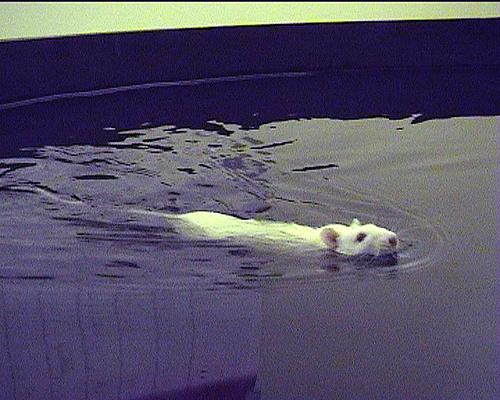
In behavior, consider the tendency for a rat to swim across a small pool in order to obtain food. The rat has a reason (obtaining food) to do the swim, and a different reason (avoiding cold water) to not do the swim. The rat's reasons shape its behavior as measured by whether it swims the pool, yet they do not violate physical conservation laws:  the choice of behavior is done by an open system (the rat) which is not subject to conservation of energy or mass requirements, since the system is not closed:


Whishaw IQ, Pasztor TJ. Rats alternate on a dry-land but not swimming-pool (Morris task) place task: implications for spatial processing. Behav Neurosci. 2000 Apr;114(2):442-6. PubMed PMID: 10832805.

It's important to make the above point about reasons for behavior and the conservation laws, since in philosophy of mind it is sometimes claimed that causal closure of the physical means that mental reasons for choices cannot determine our actions unless they are themselves physical (i.e unless a reason is somehow identical to a particular brain configuration).  That stricture is based on a flawed, kinetic model of causation.  In an open system, mental properties (as opposed to physical properties) of the organism may affect the probability of a behavior without violating any conservation laws.  Causal closure need only apply to systems as measured under the constraints of the mass/energy/momentum conservation laws. Thus, behavioral choices need not be epiphenomenal or forbidden due to any causal closure concerns.


Ciguatera in Hawaii

Above is a map of fish ciguatera levels found in fish caught on the Big Island (courtesy Dr. Paul Bienfang of the oceanography department at the University of Hawaii in Honolului).  Although never seen at the high levels seen in the Caribbean such as South Florida, it's still a risk of seafood consumption here.

Ciguatera is a gastrointestinal, cardiovascular, and neurological illness which is caused by the eating of fish which have eaten other fish which have eaten a tiny free-swimming organism, the protozoan dinoflagellate called Gambierdiscus toxicus.

Gambierdiscus makes a toxin (ciguatoxin) which is not metabolized by fish, so that it is concentrated along its path in the food web.  Thus, eating large carnivorous fish such as large moray eels or barracuda are more likely to cause the illness. Unfortunately, unlike the more common bacterial food poisoning toxins, ciguatoxin is not broken down by cooking. The toxin causes increased permeability of the resting axon sodium channel, increasing depolarization and thus directly activating sensory and other peripheral and indirectly central nerve circuitry (though the toxin is excluded from the brain itself, since it does not cross the blood-brain barrier).

Symptoms of ciguatoxin poisoning include nausea and vomiting and diarrhea, symptoms typical of other types of food poisoning and gastroenteritis.  Unlike those conditions, the GI problems are accompanied or followed by numbness and tingling in face and extremities, often around the lips or mouth. A pathonogmonic complaint is reversal of hot and cold, so that hot objects feel cold and vice versa. Cardiovascular symptoms are due to autonomic dysfunction with bradycardia and hypotension which may cause syncope. Fatigue is common but actual weakness or paralysis is rare, unlike botulism.

Since ciguatoxin is stored in the fat depot of the body and not broken down, previous bouts of the poisoning may actually make future bouts more likely and lead to chronic nervous system symptoms in those with ongoing exposure. Fortunately, recovery is the rule once further toxin exposure is removed.

According to the University of Hawaii, ciguatera increases in times of higher water temperature in the late summer.  That's the next 3 to 4 months here.


New study published on NPH this month.

Normal pressure hydrocephalus (NPH) is a less common cause of dementia than Alzheimer disease, Parkinson's, or multiple stroke. Classic...